
 cohabit insuranceSmarter insurance for your strata building.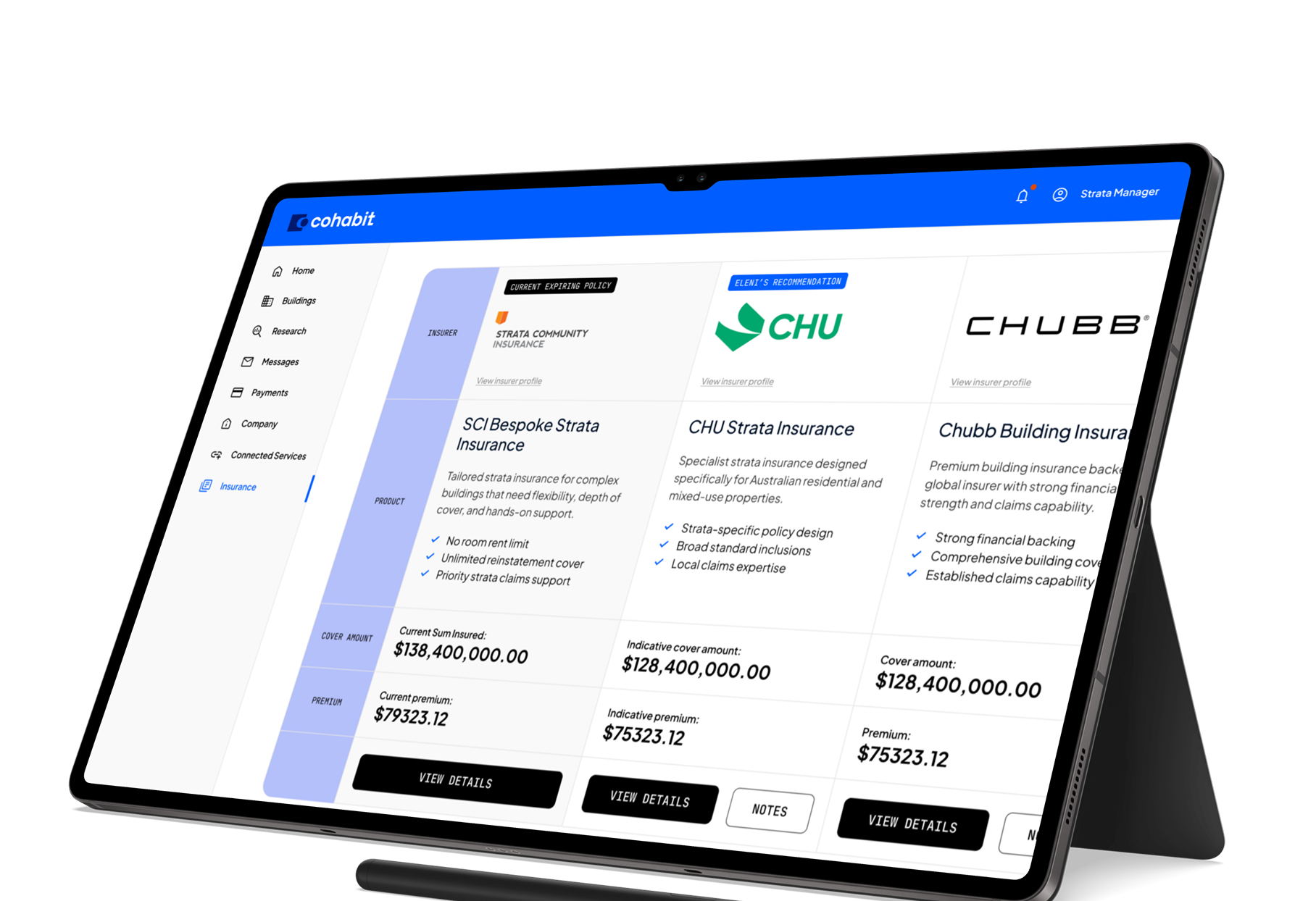
Frequently Asked Questions
Common questions answered clearly.
What is a strata building?
A strata building is a property divided into individual lots — such as apartments or townhouses — with shared common areas like lobbies, gardens and carparks. Each lot owner holds title to their individual space and a share of the common property, which is collectively managed by an Owners Corporation (also called a Body Corporate in some states).
What records am I entitled to access as a strata owner?
As a lot owner, you are legally entitled to access all records held by your Owners Corporation — including financial statements, meeting minutes, insurance documents, maintenance records, by-laws and compliance documentation. In practice, accessing these records can be time-consuming and inconsistent. Cohabit brings them together in one place.
What is a capital works fund?
A capital works fund (also called a sinking fund) is a reserve of money set aside by an Owners Corporation to cover major future expenses — such as roof repairs, lift replacements or facade works. A healthy, well-funded capital works fund is one of the strongest indicators of a building's long-term financial stability.
What is a strata levy?
A strata levy is a regular contribution paid by lot owners to cover the costs of managing and maintaining the building. Levies typically fund both day-to-day administration (the administrative fund) and longer-term capital works (the capital works fund). Levy amounts vary significantly between buildings based on size, age, condition and management costs.
What is an Owners Corporation?
An Owners Corporation (known as a Body Corporate in Queensland and some other states) is the legal entity made up of all lot owners in a strata scheme. It is responsible for managing common property, maintaining insurance, enforcing by-laws and making decisions about the building's future. Day-to-day management is often delegated to a professional strata manager.
What is a strata committee?
A strata committee is a smaller group of elected lot owners who act on behalf of the Owners Corporation between general meetings. The committee makes routine decisions about building management, approves expenditure within set limits and liaises with the strata manager on behalf of all owners.
Still have questions?
If you didn’t find your answer, feel free to reach out
What is a Building Health Score?
The Cohabit Building Health Score is a data-driven score that summarises a strata building's overall health across five categories — financials, building condition, compliance, liveability and sustainability. It's designed to give buyers, owners and professionals a clear, at-a-glance view of how a building is performing — and where risks may exist.
How is the Building Health Score calculated?
The score is built on hundreds of structured data points drawn from strata records, inspection reports, financial statements, insurance documents and compliance records. Each category is weighted by its impact on overall building health and benchmarked against similar buildings across Australia.
How often does the Building Health Score update?
The Building Health Score is a living score — it updates continuously as new data is added and verified. As strata records, inspection reports and financial documents are ingested into the platform, the score reflects the most current available view of the building's health.
What data does Cohabit use?
Cohabit ingests and structures over 595 data points per building — including strata records, financial statements, meeting minutes, insurance documents, inspection reports, maintenance history, compliance documentation and building metadata.
How does Cohabit get access to building data?
Owners and buyers are legally entitled to access all records for strata-managed buildings. Cohabit facilitates this through a simple request model — when a user searches their building, Cohabit gathers all available records on their behalf, structures the data and builds a comprehensive building profile.
Is my building's data secure?
Yes. Cohabit takes data security seriously. All building data is stored securely and handled in accordance with Australian privacy legislation. You can read our full Privacy Policy at cohabit.com.au/privacy.
Still have questions?
If you didn’t find your answer, feel free to reach out
Is strata insurance mandatory in Australia?
Yes. Strata insurance is a legal requirement for all residential and commercial strata-titled properties in Australia. At a minimum, Owners Corporations are required to hold building insurance, common property insurance and public liability cover. Specific requirements vary by state and territory.
What does strata insurance cover?
Strata insurance typically covers the building structure, common property and shared facilities, permanent fixtures within each lot and legal liability for incidents on common property. It does not cover personal contents, tenant belongings or landlord-specific risks — these require separate policies.
What's the difference between strata, landlord and contents insurance?
Strata insurance covers the building and common property — held by the Owners Corporation on behalf of all owners. Landlord insurance covers risks specific to leasing a property. Contents insurance covers personal belongings within an individual lot. Owner-occupiers, landlords and tenants each need their own cover in addition to the building's strata policy.
How often should a strata building be revalued for insurance purposes?
A formal valuation is typically required every three to five years, but it is considered best practice to review the sum insured annually and obtain updated valuations every two to three years given rising construction costs.
What is underinsurance and why does it matter?
Underinsurance occurs when a building's insured value is insufficient to cover the full cost of rebuilding following a loss. It is an increasing concern across Australian strata — particularly as construction costs rise. If a building is underinsured at claim time, the Owners Corporation may face a significant shortfall.
Why use a specialist strata insurance broker?
Strata insurance is complex — especially for buildings with defects, compliance issues or challenging claims histories. A specialist broker has access to a full panel of underwriters and can negotiate coverage and pricing that a general insurer may not offer. Cohabit Insurance uses real building data to provide more accurate risk assessments and better outcomes.
Still have questions?
If you didn’t find your answer, feel free to reach out
What should I check before buying a strata property?
Before committing to a strata purchase, it's important to review the building's financial health (levy levels, capital works fund balance, any special levies), physical condition (known defects, maintenance history, outstanding works), compliance status (insurance, fire safety, regulatory obligations) and governance records (meeting minutes, by-laws, committee activity). A Cohabit building profile brings all of this together in one place.
What is a strata report and what does it include?
A strata report (also called a strata inspection report or section 184 certificate in NSW) is a document prepared by a licensed inspector that summarises key information about a strata scheme. It typically includes financial records, meeting minutes, by-laws, insurance details, correspondence and any known defects or outstanding levies.
What is Instant Intelligence?
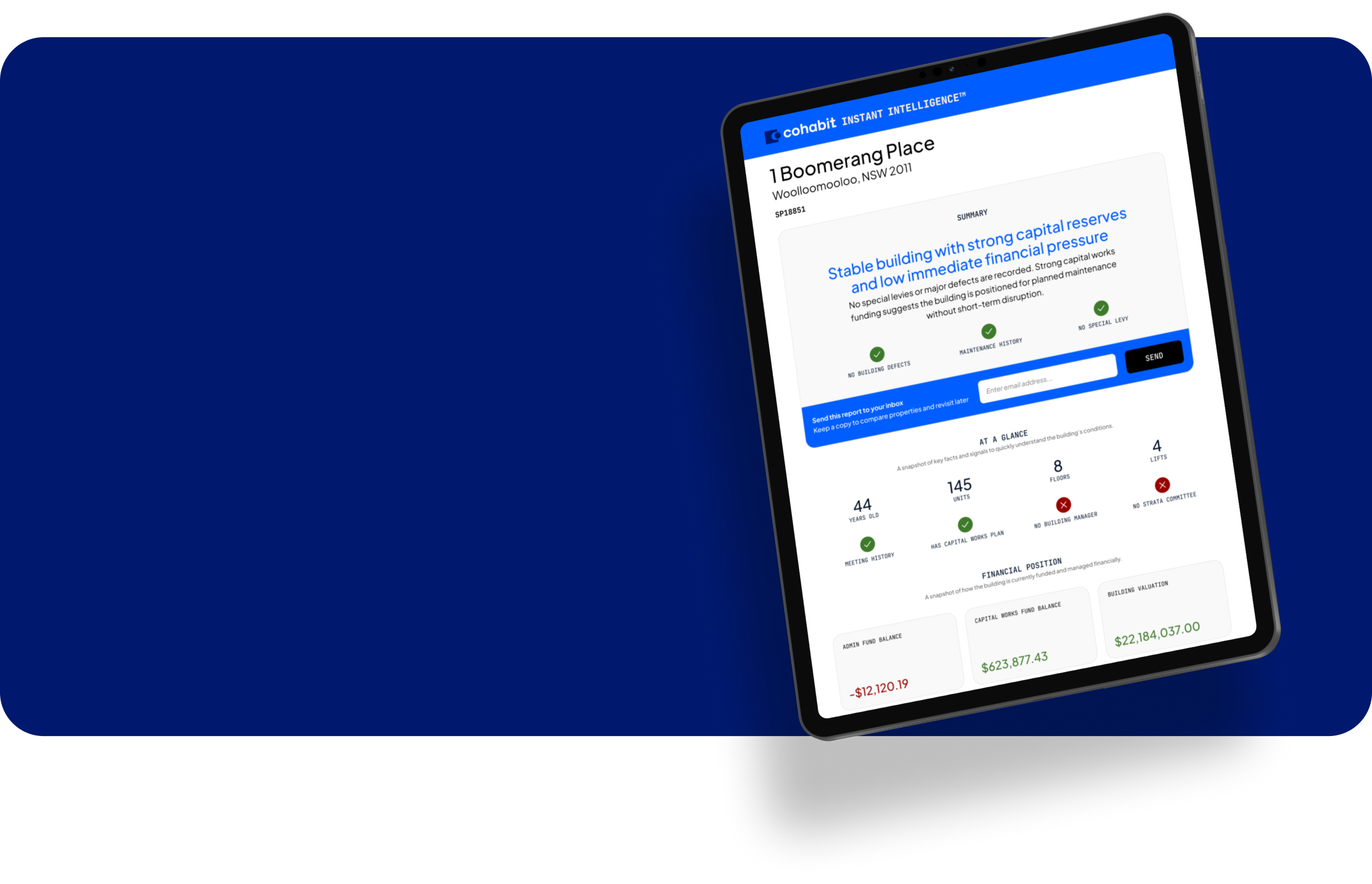
Instant Intelligence is a free Cohabit tool that lets buyers upload a strata report and get instant, plain-language insights on the building's health, risks and financials — without needing to create an account.
What's the difference between Instant Intelligence and a full Cohabit building profile?
Instant Intelligence analyses the strata report you upload — giving you fast insights based on the documents you already have. A full Cohabit building profile goes deeper, ingesting all available strata records, inspection reports and financial statements to build a comprehensive, continuously updated view of the building.
Do I need a Cohabit account to use Instant Intelligence?
No. Instant Intelligence is fully open — no account needed. Simply upload your strata report and get your insights in seconds, for free.
Still have questions?
If you didn’t find your answer, feel free to reach out
Help & Guides
How-to articles and platform support

Start with clarity. Stay in control.
Get your free Cohabit profile in seconds.
Get Started